Pages

Thursday, 3 December 2015

'Innovation-Only' Climate Inactivism: Our rebadged reliance on outdated technology

For five years, the rejection of climate science seemed like the best option for protecting technologies that rely on fossil fuels. But pumping money into organised denialism is becoming less effective - public acceptance of climate science is slowly increasing, and the field of climate denial has attracted a broad collection of awkward cranks.

Hence, the need for a re-brand. This isn't unambiguous scientific denial - it's climate inactivism - passionately arguing and advocating for the absence of any action to reduce carbon emissions.

A key component of inactivism has been an effort to frame fossil fuels as a moral imperative - an argument that was born in US fossil-fuel-funded think-tanks and that has now been adopted by the Australian government, the conservative media and the Minerals Council. They're not normally the groups you'd see arguing for collective action to altruistically assist those in need, but they make an exception when it comes to advocating for fossil fuels.

There's a new component of climate inactivism that's re-emerged during the 21st Paris Conference of Parties. It's explained neatly in an editorial, in The Australian:

"Green technologies are not yet mature and not yet competitive, but we insist on pushing them out to the world. Instead of production subsidies, governments should focus on making renewable energy cheaper and competitive through research and development. Once the price of green energy has been innovated down below the price of fossil fuels, everyone will switch.” 
Dr Lomborg greeted the Mr Gates-led coalition as a positive sign confirming innovation as the key to climate mitigation. But he points out that today’s favoured subsidies do not encourage innovation, instead making companies stick to inefficient but subsidised technologies such as solar and wind power"

Lomborg is the chief proponent of the idea that logical outcome of the need for research is the immediate cessation of all government support for all clean technologies - a fallacy that's republished verbatim in the editorial.

The declared 'insufficiency' of wind and solar somehow transforms into "inefficiency", and The Australian then suggests we replace government support of clean technology with research - "instead of", rather than 'in addition to'. It's a popular concept, because it avoids, entirely, the need to reduce carbon emissions by any quantity in the coming decades.

So, because existing technologies can't immediately and entirely replace the world's energy system we shouldn't be encouraging their deployment anywhere, ever. This re-branding of denialism seems to manifest in the creation of this weird gradation:


People find themselves welded to a spectrum, according to their views on technology, their ideological underpinnings and their general worldview. I really don't think we need to slide along the single dimension offered by the approach above.

I agree with the idea that greater spending on research and innovation is a good thing for the clean tech industry, and decarbonisation. We'll get deeper, faster cuts if we do this, which is why Bill Gates' 'Mission Innovation' project is a good thing.

I also agree that we could potentially decarbonise using technology we have today - the Australian Energy Market Operator did a great report illustrating that pre-existing technologies might do the job, assuming some 'anticipated technology cost reductions and performance improvements'. But this isn't about potentials, anymore - it's about rate-of-change.

"Figure 7: Optimised generation mix – total energy generated" from AEMO's modelling exercise

Progressives recognise that the 'innovation-only' end of the spectrum is a branding exercise for continued inaction. Conservatives recognise that subsidised deployment leads to a quantifiable threat to the market share of carbon-intensive fuels. Both sides spy an ideological trojan horse embedded in ideas that are, in and of themselves, good ideas. Both sides are right: this is how humans beings deal with the world - through the lens of our own package of biases and ideologies. But this isn't a case of both sides being 'equally wrong'.

The progressive half of politics in Australia has done a lot for clean technology research and innovation, and the conservative half has mostly sought to destroy it. Looking back on the past three years of Australian energy policy, and the subsequent halt on clean technology construction, that's an inarguable point.

It's extremely important to note that the Australian Greens and the Labor Party were responsible for the creation of two agencies dedicated to research, development and innovation - ARENA and the CEFC. But, it's still government policy to continue attempting to abolish these two agencies. When the attempted abolition of these bodies was first announced in the 2014 budget, it was hailed in The Australian as an 'impressive first step'. Research and development, once it actually starts happening, is perceived as a threat that needs to be obliterated.


This approach continues once technologies reach maturity. Opponents of renewable energy have focused heavily on the propagation of health fears around wind farms. Currently, a newly-created government role to receive complaints about wind farms will cost $600,000, and the National Health and Medical Research Council has been compelled to set aside $2.5 million, specifically to commission scientific studies of 'wind turbine syndrome'.

The West Australian state government is now charging a tax for those who dare to reduce their electricity demand through rooftop solar. The large-scale renewable energy target, which saw the successful installation of several thousand megawatts of clean technology, was reduced this year, on the basis that the reduction was justified by the previous period of anti-renewable energy campaigning.


Deploying existing technology leads to a quantifiable reduction in carbon emissions, in the energy system. Below, I've done an estimate for each month so far this year, using the power output of wind and the two large-scale solar plants registered on the electricity market, of emissions saved from the use of clean technology that exists, and is churning out megawatts right now:

Emissions intensity is the average NEM fossil fuel intensity for each interval, using existing generators

If we adopted the approach advocated in The Australian, the chart above would be zero for each month. The deployment of clean technology, and subsequent reduction in carbon emissions, has happened through the creation of government schemes - schemes that 'innovation only' climate inactivists openly seek to completely destroy. Genuine R&D might double or triple the height of those green columns, in half the time. Imagine that.

Here's the thing: every single technology that emerges from the billions of dollars of investment in research and development will face extremely passionate opposition from incumbent polluters. Even if we created a technology that could compete effectively with coal through innovation and research, it faces a decade of manufactured syndromes, government health studies, Prime Ministerial declarations of ugliness and outright denialism.

The goal, for those hijacking the reasonable push for increased innovation and invention, is to lock-in the reign of harmful technology for another few decades. Paired with the illogical and awkwardly adopted moralising, and a sprinkle of standard scientific denialism, we're wedded to a collection of technologies for which we'll pay the price, with no share of the profits.

*Updated - amended wording about AEMO 100% renewables report to be clearer on cost and performance assumptions

Monday, 30 November 2015

The Weird Pendulum Swing of Dawkins' Ideology

When I was in year 11, I read a book called The Selfish Gene, by evolutionary biologist Richard Dawkins. It's a great piece of science communication. It inspired me to make a lego DNA model for my high-school biology project. The idea that much of what comprises our identity is contained in this ribbon of code seemed genuinely wonderful, to me.

My Lego DNA model, featuring falling Technics guy

But I have to admit, part of why I loved The Selfish Gene so much is because it seemed a closer linkage to reality than the book some avowedly creationist peers in biology class were reading. It was the same with his later work, The God Delusion. That book wasn't about science communication, but it described a philosophy that I already subscribed to, and put my frustration into words. It also made feel like I had access to an insight that was being ignored by most other people.

Dawkins now seems to exemplify the things that he once called out: namely, succumbing to some internal force that draws you away from rationality, and failing to recognise when bias and the unconscious defence of belief is tugging you in some unpleasant direction.

It's nearly a full decade since I first read The God Delusion. Now, Dawkins is tweeting obsessively about a teenage boy, Ahmed Mohamed, who was recently arrested in Texas for bringing a homemade clock to school, for a science project. The clock was mistaken for a bomb, and Mohamed was arrested:


There's something about that photo that kind of gets to me. The NASA shirt is instantly disarming, and of course, his arrest is indicative of irrational racial profiling - the idea that you can spot a threat by the origin of someone's surname, rather than evidence-gathering and analysis.

Dawkins hasn't discussed the serious implications of Mohamed's wrongful arrest. He's focused instead on the authenticity of the clock, and  is now firmly convinced that the teenage boy removed a clock from its housing and offered that as his own work. Follow the reply threads on Twitter you'll see the regular assertion that the family orchestrated this as an intentional hoax, designed to provoke a response.


It's pure conspiracy theory - the assumption that intentional agents are orchestrating events, rather than a natural emergence of patterns. It's an odd pendulum swing. Believing that expected occurrences are orchestrated by a single organism is one of the things that leads to a belief in, say, creationism - and it's also something that, when combined with Dawkins' genuine hostility towards Islam, leads him to attribute some over-arching scheme to this teenage boy's high school project.

I see this a lot. Senator David Leyonhjelm, who is ideologically anti-government, hates government support for wind energy so much that he advocates for government regulation of wind farm projects - regulation funded by the taxpayer (the recently announced 'wind commissioner' role, requested as part of an inquiry helmed by Leyonhjelm, comes in at $600,000).

This is a standard feature of feeling your way through the world by adhering to pre-determined schema, rather than mulling over issues using your noggin. You will be weirdly driven towards whatever thing it is that you're railing against, and you won't blink an eye when someone highlights your hypocrisy. Guaranteed.

In an effort to refute accusations that he was embarking on a vendetta against a kid, Dawkins awkwardly juxtaposed Mohamed's recently-announced $15m lawsuit with the actions of a 10-year-old boy being forced by an ISIS fighter to decapitate a Syrian officer:


He's baffled and outraged by the suggestion that he was directly equating Mohamed's alleged "hoax" with the actions of the child in the linked article. But his tweet, the reaction and his subsequent defense illustrate an important point that he's never understood: if everyone fails to understand something the way you understood it when you wrote it, you are a bad communicator. Also, there won't be a single interpretation of what you said: context, attitude, sentiment and timing all impact how your message sits inside the brain of those who choose to consume it.

Even if Dawkins' assertions are true, and Mohamed has committed the unforgivable crime of not  manufacturing an electronic timepiece from raw mined materials, Dawkins has fallen deep into a hole of weird conspiracist reasoning. Take, for instance, the classic 'if you don't believe me, google [x]' argument:


It should be relatively easy to spot the error in reasoning, here. You can't determine whether something is real by simply googling it - research is effortful, and often google is used as a tool to find a collection of links that agree with your worldview, rather than a broad synthesis of research or evidence-based arguments. Finding evidence isn't enough - you need to know how to evaluate it:

“Do not indoctrinate your children. Teach them how to think for themselves, how to evaluate evidence, and how to disagree with you"

Dawkins said that in The God Delusion. His plea, to advocate for a greater spread of critical thinking, directly contradicts his newfound attitude: if you don't believe me, just google it.

The clock-trutherism might just be a some sort of ideological defense - the creation of a narrative that negates the threat to his worldview. In this case, it's the preservation of organised religion (and its adherents) as consistent aggressors. It extends to the lawsuit thing, as well. In America, there is a new lawsuit every two seconds, but Dawkins sees the response of the boy's family and declares it part of the conspiracy (that's not to say the lawsuit is a good thing - just that it's unremarkable).

Jeff Sparrow writes in The Guardian about Dawkins' increasingly steep descent into irrationality:

"You can proclaim you’re an atheist, a freethinker, a devotee of the enlightenment – and yet somehow still end up backing rightwing Christians like George W Bush and Ben Carson in their campaigns against the Muslim hordes. 
Which is why it’s not enough to denounce Dawkins and Harris. If we’re to save the good name of atheism, we need to popularise a fundamentally different approach, one that seeks to understand religion rather than simply sneering at it"

I'm not sure I agree with all of Sparrow's piece, but he makes a monumentally important point: injecting a dose of empathy and a time of listening both go a very long way. I'd argue that it's more rational to spend time understanding the gears inside someone's head - what's made them turn to organised religion? Why is someone rejecting the science of vaccination? It's almost never 'stupidity' - it's usually a complex brew of sentiment and cognitive bias - you can't counter it with assignations of ignorance. It's also rational to work towards effective communication. Being right is half the game, not the whole game. You need to be right, and to be heard.

Dawkins prodded me into the very real and thrilling joy of understanding science. But his attitude and approach are leading to increased prevalence of the precise things he's railing against. This pendulum swings with such momentum that Dawkins now exemplifies conspiracist ideation and irrational discrimination.

A confession: my brother helped me make my lego DNA model. Like..majorly. He did all the hard bits, and I just finished it off. Come at me, Dawkins.

Tuesday, 24 November 2015

Clarification from Ketan Joshi to Sarah Laurie

I am a Research and Communications Officer employed by Infigen Energy, which operates wind farms in Australia.

On 29 June 2015, in the context of a series of tweets describing the proceedings of a public hearing of the Senate Select Committee on Wind Turbines, I published the following tweet:


In the interests of avoiding confusion, I would like to re-state that the allegation contained in the tweet by Ken McAlpine, linked to in my tweet that Sarah Laurie is a “deregistered” medical practitioner, is without foundation and entirely false.

I would like to reassert that Sarah Laurie is not deregistered and has never been sanctioned by the Medical Board of Australia.  Sarah Laurie allowed her registration as a medical practitioner to lapse for personal reasons.

Ketan Joshi
Research and Communications Officer
Infigen Energy

Tuesday, 10 November 2015

Why incumbency breeds tone-deaf social media - #YourTaxis and #CoalisAmazing

Social media, and Twitter in particular, is experiential, confessional and largely anecdotal. By design, it isn't a good medium for level-headedness or facts. It's a hazy, roiling shitstorm of japes, memes, in-jokes, stories, pictures, abuse and friendship. It sounds unpleasant, but it's sometimes quite nice.

For most organisations and corporations, it's largely a tool for injecting tiny bits of information into the mass of shifting, uncontrolled chaos. Most of the time, it meets this need with unremarkable ease.

But for industries that are facing widespread unpopularity or the onset of competition, social media is sold to them as the precise opposite: a predictable, meaningful and manipulable collection of willing participants, ready and waiting to be convinced of the merits of a thing.

The most recent victim of this fallacy is the Victorian Taxi Association (VTA). The #YourTaxis campaign, designed to encourage taxi users to write-up stories of their experiences, was managed by Melbourne PR agency Ellis Jones. It hasn't gone well:


This isn't the first time an ill-conceived hashtag has been hijacked - remember #QantasLuxury and #FreshInOurMemories? But I think the Victorian taxi industry is different. This error was caused by the VTA assuming that heavy public usage of their product is due to their popularity, rather than their monopoly. The site is plastered triumphantly with statistics on the huge number of vehicles and trips in Victorian taxis


Like many people, I tend only to use taxis when I need to. In this situation, we're faced with a  choice: take a taxi, or walk some enormous, unfeasible distance. Our reliance on taxis does not signal a love of taxis. Being forced to use this specific service means many, many negative experiences - you, and all of your friends and family, have had them.

In fact, it seems people are waiting impatiently for alternatives - this is where Uber, an American ride-sharing service (with a interesting skill in marketing and PR - they once delivered kittens, but largely only to media outlets) rides the wave of public grievance, and they profit.

The VTA are now insisting that around five thousand personal and public declarations of horror, inconvenience, racism, sexism and sexual assault are a Good Thing:


The CEO of the VTA said:

"The response online over the past 24 hours isn't anything we didn't expect. We asked for feedback and we got it. The good and the bad and everything in between” he went on. 
"It also demonstrates the number of people that rely on taxi services and we want to make sure our service continues to meet customers' expectations in a period of rapid change.” 
"We will respond to everything that comes our way on YourTaxis.”

They've accidentally identified the root cause of their problem, here. A large number of people do rely on their services. This is why the several hundred stories of sexual assault should trigger serious changes, rather than cheerful promises.

It's also misleading for them to frame their campaign as a feedback initiative - if it was, they'd have simply designed a survey, collected the results, and implemented changes, without the fanfare. My own experience is that it works well, when you do a representative questionnaire.

This incumbency/popularity confusion is also the root cause of the Minerals Council #CoalisAmazing backlash, which followed almost exactly the same trajectory. Twitter didn't respond positively to that campaign, either:


And the organisation behind the campaign also clumsily insisted it wasn't bothered:

"We've been delighted,"  
"We completely anticipated it, we revel in it. 
"We fully expected that there would be parodies and we would've been disappointed if there weren't some."

It's weirdly similar to the VTA's insistence that they're unsurprised, unbothered and pleased by the response. It might even be true, but it comes across as completely insincere, and sour-faced.


And, of course, they also repeat, proudly, how much everyone is forced to rely on their product. The Minerals Council trumpets statistics showing coal's dominance in Australia, in the precisely the same way the Taxi Industry does:


Part of the reason coal dominates our fuel mix so profoundly is the fact the power stations were paid for by state governments when they were built. New, clean power stations don't get lump-sum government support - it has to be earned per megawatt hour - and this support is angrily opposed by the now-incumbent, carbon-intensive generators.

All this does is remind people that no matter how hard you try, you don't have a choice. The electricity flowing into your powerpoints will be generated from inefficient, heavily-polluting dead old plants, so you better learn to love it. And your trip home at 3am, after public transport shuts down, will be in a taxi that you have to shed blood and tears to find and capture - if you're less than 10 kilometres away, you won't be getting on at all, so you better learn to love it.

This is why people like the idea of rooftop solar, grid-connected utility-scale wind, Uber, Lyft and Go-Get. Incumbents are in a position where they are free to ignore public opinion, and they almost certainly will. #Coalisamazing and #YourTaxis aren't surveys designed to determine the shape of public sentiment; they're misguided attempts to wrangle popularity.

Incumbency create a permanent state of tone-deaf social media confusion.

Instead of paying for risky social media campaigns, they could invest in new technology - upgrading systems to meet or even out-perform new entrants; blending their experience with cleverness and novelty. It won't happen. Social media will continue to be presented as a conduit for manipulation, reliant on this confusion between incumbency and popularity.

----------------------------------------------------------

Update - Victaxis seem to have ditched the social media agency after a poorly-considered tweet about Remembrance Day. Meanwhile, the American 'I Love Fossil Fuel' coal-lobby account has sent a nearly identical tweet, hijacking remembrance day to push their agenda. Both accounts managed to misspell 'remembrance' (Victaxis even misspelled it in their apology):


Tuesday, 3 November 2015

No, wind farms did not cause Adelaide's power outage

Last Sunday, there were widespread power outages in Adelaide, due to what seems to be a combination of planned maintenance on one of the two interconnectors between South Australia and Victoria and a collection of other outages. The link between the two states was partly severed, and 160 megawatts of flow from the interconnector vanished instantly. This causes a sudden change in frequency, and to balance this loss of power, some demand had to be shed, causing the outages.


As you might expect, this easy-to-understand series of events serves as a great little substrate for panicked assignations of blame, devoid of evidence or analysis - check out these two articles for some actual numbers around the issue.


Attributing this incident to the presence of renewable energy isn't supported by evidence. Single events like Sunday's outages don't suggest a prior or looming trend of frequent outages caused by renewables. Heard, at least, is willing to engage with this question on Twitter.

But Andrew Bolt, a blogger for News Corp, takes what might normally be a subtle, calculated effort to heap blame on any technology that doesn't burn compressed dead old plants to get power, runs with it, and fumbles in the process. It's like that brave seagull you always see at Circular Quay, that steals an enormous sandwich, thinking it's done something totally great, but then proceeds to drop it into the ocean. Then it just hovers, squawking with angry confusion at the foregone bounty, as the square of sodden oceanic food expands into nothingness.

------------------------------------------------------

Andrew Bolt's piece, here, is cleverly titled "Wind don’t blow, South Australia don’t glow". This is an attempt to distract you from the fact that power supply in SA continues uninterrupted during low wind periods, because you're dazzled by the revolutionary, inventive rhyme that's been deployed in the headline.

IT RHYMES THEREFORE IT IS TRUE AXE TAX WIND BLOW POWER FLOW GLOW YAY RHYME

In the image above, you might notice a chart of wind power. Look at that drop! Wind power is the worst!..............except, Bolt seems to have presented a chart of wind power output on May 25th this year, not Sunday the 1st of November.

The 1st of November is a full 160 days from Bolt's chart. Weirdly, Bolt has picked a single day - specifically, one in which the change in output looks dramatic due to the scaling on the y-axis of his chart. Let's look at 25/05/2015 in context:


It's a little disappointing that he didn't choose the 3rd. Maybe he was trying to be generous? Or maybe the change in wind speed wasn't spooky enough? Anyway, it gets worse.

"South Australia’s Premier likes to boast his state has more wind power than any other.....what he doesn’t add is that this not only gives South Australia the country’s highest power prices and a dependency on Victoria’s coal-fired power"

This is the part where the seagull soars through the air, but begins to feel the sandwich falling from its beak. He  claims that SA's power price is the highest in the country, due solely to wind power - he uses the word "gives". Australian Energy Market Commission data shows pretty clearly how weird that claim is.

First, we can say with confidence that SA has relatively high power prices. The following shows FY15 costs:


Hmm, okay. So SA has the highest cost, and the highest wind power penetration (about 30%). Since good ol' common sense tells us that if two things that happen at the same time, one thing has definitively caused the other, we could stop here.

But, well, sod it, let's look at the percentage contribution of the LRET, the scheme that supports wind development in Australia, for each state, for the same year:


SA's high retail costs aren't caused by wind farms. SA's LRET cost, as a percentage of total bills, is the second lowest (it's 2.17%, only the NT has a lower percentage, at 1.48%).

Shucks. Turns out you can't establish a causal relationship because two things happen at the same time. This piece of knowledge is really going to shake up public discourse.

After providing some handy links to an anonymous anti-wind blog that regularly posts death threats and racist abuse, Bolt quotes from an article in the Adelaide Advertiser:

"A spokesman for SA Power Networks said the state lost supply from “upstream” when the interconnector shut down, triggering an automatic loss of power — load shedding — in SA, resulting widespread outages…When the Victorian system shut down, 160 megawatts of energy was lost and wind power did not supply energy because it often does not start until 3am."

Oh, boy. I don't even know where to start. The last sentence seems to have been added in by someone who literally just threw in a reckon into their article. Readers were entirely convinced by this too - many of the comments express a hatred of wind power as a consequence of this weird, invented claim.


First, megawatts are power, and megawatt-hours are energy. So, the lines 'megawatts of energy' and 'power did not supply energy' aren't exactly filling me with hope that our reckoner understands the basics of the national electricity market.

So, did "wind power not supply energy" (it hurts, typing that)? Here's a chart of output by fuel type for the night of the 1st, on which the power outages occurred:


At the time of the outage, 21:55 NEM-time, wind power in South Australia was producing 221 megawatts. It continued at that level for the next hour, and wind speeds across SA gradually decreased throughout the next morning. So, it's completely wrong to say 'wind power did not supply energy' (it kept producing over time), or even 'wind power did not supply power' (it was producing when the IC broke).

This is roughly the point at which our seagull is watching its coveted sandwich plummet towards the dark green surface of Sydney harbour.

What about "often does not start until 3am"? Are wind speeds over South Australia directly connected to Central Standard Time? Does Andrew Bolt really believe that the atmosphere refuses to move until a specified time, every day? Let's look at average wind power output in SA, by hour, so far this year:


Obviously, averages don't tell the whole story, but this is more than enough to dismiss that weird, casual statement about diurnal variations in wind speed. In fact, that profile is neatly opposite to SA's solar power output, which is a good thing in the long run.

Yes, South Australian wind power was producing at the time of the blackout, and no, the atmosphere doesn't wake up at 3am. This is where our seagull friend simply hovers above the inedible, putrid sandwich, wondering what went wrong, squawking at nothing and no-one in particular.

------------------------------------------------------------------------------------------

Over the next few weeks, there will be quite a few attempts to induce fear and anxiety about South Australian renewable energy, using this event as a basis. They'll over-egg the risks presented by variable-output power, and they'll completely ignore the risks presented by a total reliance on outdated, carbon-intensive fuels and technologies. Some of these attempts will be more subtle than others. These claims are somewhere in the angry-seagull-that-lost-a-sandwich zone.

Click here to access the raw data used for this blog post - please don't republish this post without first checking with me :) Thanks :) 

Sunday, 25 October 2015

We might all be doing it a little bit wrong

Okay, the blog title's a bit of a cop-out, but this is a principle that's both exceedingly obvious and extremely hard to come to terms with.

When I say 'wrong', I don't mean a failure to synthesise and prosecute facts obtained through the scientific method. Our ability to do that should simply be a base minimum. What I mean is that communication needs to happen in a way that makes things better, not worse. If we make things worse, we're doing it wrong.

---------------------------------------------------------------------------------

Recently, the NSW Assistant Minister for Health, Minister for Mental Health and the Minister for Medical Research, Pru Goward, addressed a forum organised by wind farm opponents in Yass. 

""Increasingly, I am [of] the view that there is some validity on the health effects" of wind farms, Ms Goward was reported in the Yass Tribune as saying on Friday. "There are a number of people with health problems...it is clearly not psychosomatic." 
Ms Goward went further on Monday, telling Fairfax Media turbines' blades created pressure waves that "resonate in the skulls" of people living as far away as five kilometres. 
"I don't think we know enough about the impacts," she said. "It is something we should be prioritising.""

On hearing these remarks, I remembered something I'd heard a while back. It was on ABC radio Orange, on the 19th of March in 2015. You can listen to the whole clip here, but at 02:18, Goward says this: 

"That's why I think Luke Foley's decision to have no setbacks for wind turbines whilst might sound great in Sydney could be a social disaster in our region. I don't say that unwisely. a social disaster meaning it will just add enormously to the dissent, the unhappiness and the real fear people have of wind farms."

The discussion continues around the issue of setbacks, and at 4:20, the following exchange occurs: 

Interviewer: In terms of that two kilometre setback, does that bring some comfort to those who are opposed to them ? 
Goward: Oh yes. It certainly means that they can't be towering over your house. Unfortunately, wind farms companies have not always behaved properly in the past. Some people have been tricked into believing that they wouldn't have it within two kilometers, then go and look at the plans, didn't put in an objection, and the find out that they're 900 metres from their house, that's one poor family just out of Crookwell. 
The poor lady has a neurological disease and the electromagnetic radiation from the wind turbine, she's a very straight-forward farmer's daughter, but she feels that it makes her ill, because of the electromagnetic force. Of course, that's what the turbines doing, it's creating electromagnetic radiation. Look, Angela, I think we'd all agree it would be wonderful to think we had more renewable energy policies. Our policy's very focused on solar. 


This is a peculiar juxtaposition. Goward raises alarm about Foley's wind energy policies creating 'real fear', but a few minutes later, tells the tale of wind farm electromagnetic radiation having a direct, real physiological impact on human beings. It's just as vague as Goward's 'skull resonance' remarks made a few days ago. 

Despite the very-hard-to-ignore strangeness of the claims, Goward actually sort of has a point. The development of wind energy technology in rural communities does need to improve. Dissent, and unhappiness and fear all have real health impacts on communities. But seconds later, she's directly contributing to the continued emergence of these negative features of clean energy development.

Members of the NSW Liberal party attempted to defend the claim in parliament. Duncan Gay said:

"We appreciate, however, that this remains a contentious issue for some in the community, which the NHMRC also recognises. We welcome the efforts of the NHMRC to continue to support further research into this issue and we look forward to considering the outcomes of that research. The Minister for Mental Health, Minister for Medical Research and Assistant Minister for Health is my local member"

Advocating for more research isn't a defense for telling a community that it is certain that wind turbines cause harm, or that they ought to be fearful of electromagnetic radiation.

Goward's statements are relevant to a recent piece of research that demonstrates a close linkage between expectations and the triggers of annoyance. The paper concludes that:

"...accessing negative information about sound is likely to trigger annoyance, particularly in noise sensitive people and, importantly, portraying sound positively may reduce annoyance reactions, even in noise sensitive individuals"


This is a fascinating addition to an already sizable body of research that shows attitudinal factors play a big role in how we respond to novel features of our environment. Other researchers found that "A negative visual attitude, more than multi-modal effects between auditory and visual stimulation, enhanced the risk for noise annoyance and possibly also prevented psychophysiological restoration possibilities".

More directly, health warnings from authority figures are, as you might expect, taken seriously. Given Goward's prominence in the NSW health system, there's little doubt there were many in the audience who would have taken the advice to heart. It seems possible that someone might forego medical advice, thinking that some ailment is being caused by a wind turbine. This doesn't seem like a responsible thing for a health minister to say.

Goward's remarks are a brilliant example of doing it wrong. Presenting warnings about wind turbine syndrome and this weird sub-plot of electromagnetic interference in the brain isn't going to reduce 'fear' in the community. I can't imagine how Goward ever thought it would.

----------------------------------------------------------------------------------

Anyway, advocates of renewable energy do it wrong sometimes, as well. And again, by wrong, I don't mean some failure to adhere to evidence, which is a different story. I simply mean an approach that leads to an outcome opposite to the one that was originally hoped for.

In a 2008 paper called "Cool rationalities and hot air: A rhetorical approach to understanding debates on renewable energy", researchers identify some themes that pop up in UK anti-wind rhetoric:

- Sacrifice and disempowerment
- Lack of trust in government, regulatory processes and windfarm developers
- Language of war, conflict and defence
- Foreignness, aliens and anti-colonial rhetoric
- Industrialisation and commercialisation of the environment

These are all very familiar to me. They're constant features of Australian anti-wind rhetoric. But, more fascinatingly, the paper discusses themes used by supporters and advocates:

- The assumption and imperative towards consensus
- Rational, knowledge-based, scientific evidence
- Overcoming opposition
- Urgency and threat of climate change and the transition to a low carbon economy
- The discourse of ecological modernisation

The researchers essentially conclude that the constant back-and-forth of these collections of rhetorical patterns is fairly pointless.

"The assumption of expectation that consensus and agreement will rise (expressed by pro-wind discourses) is discursively weak in the sense that  
a) it is based on a flawed assumption that the main reason for anti- positions is ignorance and lack of knowledge, - hence this discourse's naive correlation between information provision and agreement - and  
b) can verge on arrogance in terms of preemptively ruling out any negotiation - which of course serves to inflame, rather than inform the debate"

The solution? The researchers suggest an attitude of conflict resolution:

"A conflict resolution approach accepts the legitimacy of pro and anti positions and movies in the direction of demanding each side engage with the other on grounds of mutual respect and as co-equals, whereas as the analysis of texts indicate there is a strong narrative of being the 'underdog' within anti-wind positions - thus making themselves out to occupy the moral high ground of the aggrieved / innocent 'victim', while pro-wind positions often present themselves as expert-based and therefore epistemically 'superior' to their opponents"

This paper was published in 2008, prior to the invention and spread of 'wind turbine syndrome'. I think the authors have a point, and we, as the advocates of technological development in rural communities, do it wrong, sometimes. But we're in a post-wind-turbine-syndrome world, now. The research is still accurate, in that simply throwing science at people won't get you far, but I wonder how effective conflict resolution is, in the face of a powerful and un-falsifiable pseudoscientific industry built around creating fear of wind energy.

This is why Goward's remarks are so harmful. People in the clean energy industry who see the value in conflict resolution rather than endless argumentation are increasing in number, but years of hard work in that area can undone in seconds, by casual utterances from people in positions of power.

We all need to stop doing it wrong, at the same time, for things to get better. But the anti-wind side will have to sacrifice a strongly-held belief in bad science and harmful, evidence-free warnings of 'skull resonance', and I wonder if that's even possible. 

Saturday, 3 October 2015

The Martian - Building a new sci-fi era, from the ground up

I hear often that people are scared of change, but I don't think that's universally true. Sometimes, we get excited by change.

I suspect the moment we landed a capsule of humans on the rock orbiting our planet felt a lot like change - a sudden, jarring update installed on our species. Except, it wasn't as monumental as we expected. Wait But Why's amazing, super-long post on space travel, Elon Musk and Mars explains this fizzled excitement in a single neat graphic:


I think the science-fiction renaissance we all kind of hoped might happen over the past five years matches this excitement trajectory quite neatly.

Big-budget, shiny, spectacular films like Gravity and Interstellar are presumed to herald a jarring shift in the waning popularity of science fiction, returning us to the heady days of 2001: A Space Odyssey and Star Wars.

But I don't think these films are going to bring about a jarring change - I think the more modest ventures are the ones that do the real grunt-work in ratcheting up the role of science in cinema. Ridley Scott's The Martian is a great example of a single point in a nice, gradual upward curve - other films like Moon, Ex Machina and Europa Report are great examples of science fiction films that are unheralded single points on this gentle upwards slope.

Via Resident Entertainment

I picked up a copy of Andy Weir's The Martian in New Zealand, recently. It's not a bad book, though it does take a little bit of time to get used to the fairly detailed considerations of mathematical problems in it. It covers the story of Mark Watney, a NASA astronaut stranded on Mars during a botched science mission. Watney's speciality is botany, and wry humour, and Weir's book is a great journey through Watney's increasingly haggard time on Mars.

The movie is astonishingly faithful to the source material. Throughout the film, I was waiting for the plot to diverge clumsily from the book, and for the awkward, inelegant fat fingers of the studio to throw in some over-wrought love interest or absurd cliché (remember that moment when Arthur Dent professes his love for Trillian the Hitchhiker's Guide to the Galaxy movie? The screenwriter insisted it had to be done, for the purpose of advancing the plot).

There are two very noticeable moments where this happens, but they're not major. They still stand out in a film that 97% well-written. In one particularly painful moment, a NASA astronaut explains something in mildly technical terms, and her colleague pleads with her to 'speak English' - you can imagine the stupendous simpleton standing over the shoulder of the screenwriter, insisting that line be inserted into the script. The other moment I can't really mention for fear of spoilers, but if you've read the book before you see the film, you'll probably squirm as much as I did. On the upside, one of the most enjoyable moments of the film, when Watney declares he wants to 'science the shit' out of his predicament, was also not in the book.

Via Newsweek

The clumsy interventions stand out, because The Martian is the first modern science fiction film that unashamedly champions engineering and science, over clumsy, clunking narrative insertions. A monologue at the end of the film beautifully describes the film's key protagonist - not Damon's dishevelled wise-cracking astronaut, but the scientific method and simply working through a problem to reach a resolution.


No narrative awkwardness is required in this film - Watney's problem-solving drives us through this journey, like his faithful, reliable Mars rover. Compare this to Gravity, in which the protagonist progresses through the film by erasing the laws of physics. Watching Sandra Bullock fire-extinguisher her way between space stations was painful. I'm much more forgiving towards Interstellar, simply because it's very high-concept, and it's also distractingly beautiful.

Interstellar was pretty, but painful

The Martian doesn't distract with purple space things. It presents a calm, deliberative approach to problem-solving as a way of surviving, as an engine for drama and exploration and emotion. It actually does this better than the book, due largely to Ridley Scott's experience and skill in this medium. And, the science is accurate - make sure you read astrophysicist Katie Mack's review of the film here.

Despite some irritating and truly unnecessary sci-fi cliche blips, the film does far more than advocate for a human mission to Mars (you should see the conspiracy theories about NASA's recent announcement of the discovery of flowing water on the red planet).

It presents the survival of a human as dependent on effort, and focus, and mathematics. So many other films assure us that peril will be resolved by unseen forces working towards our moment of redemption - that problems are resolved simply by waiting, and watching. The Martian ditches that assumption, and it's an absolute pleasure to watch.

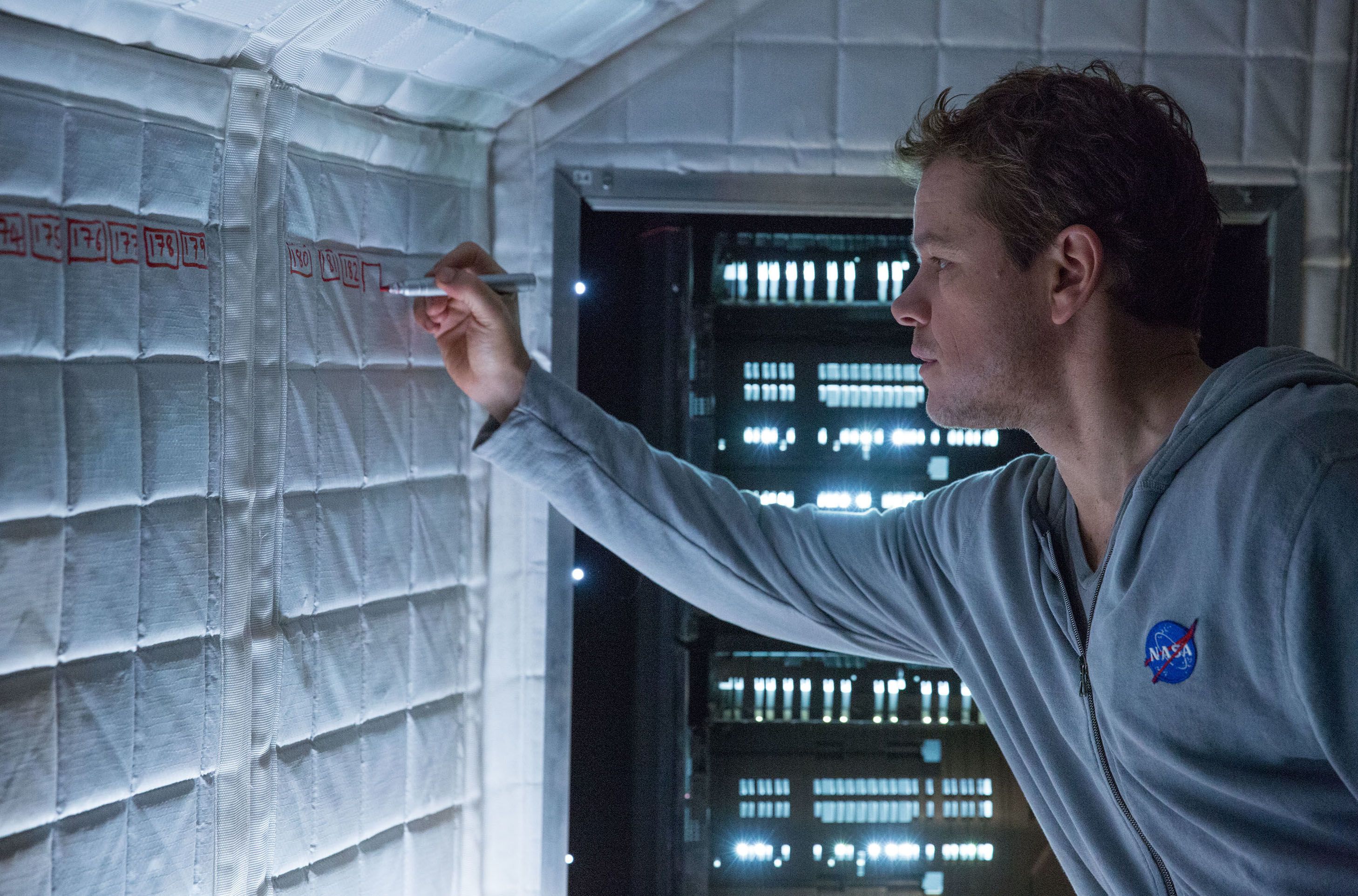
Watney sciences the shit of his wall

This film feels simultaneously minor and monumental. The modesty with which it presents this pro-scientific philosophy is important - it's a single point in what I hope is a gentle upward slope in science fiction films: cinema that presents science as a method, rather than a monster. I hope this trend is coupled to an increasing love of space travel, one that ratchets upwards over time in a sustainable trajectory. We've been without the thrill of exploration for too long, and I want to be alive when a human being touches their space-boot to Martian soil.

The film is good. Go and watch it. Four and a half stars.